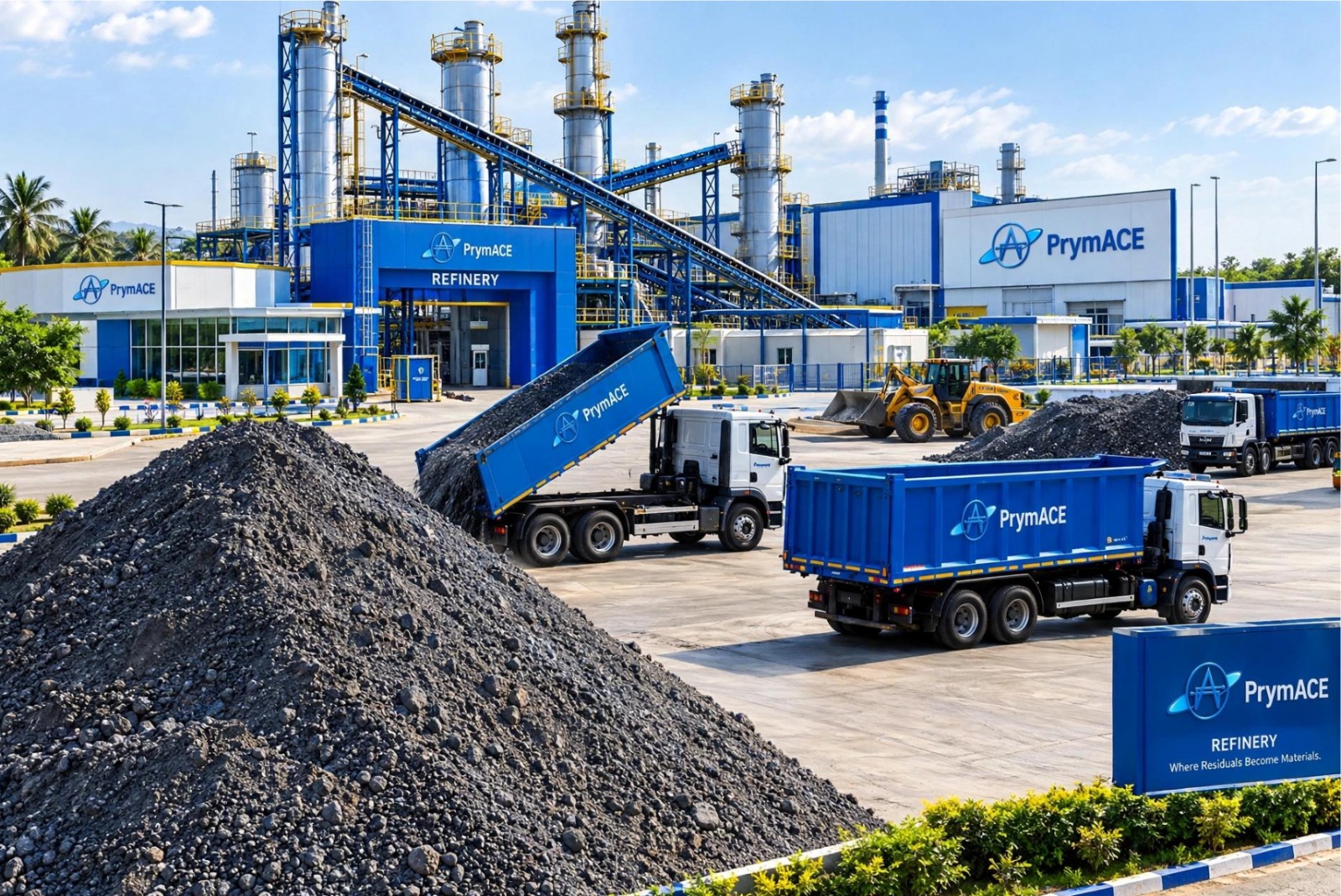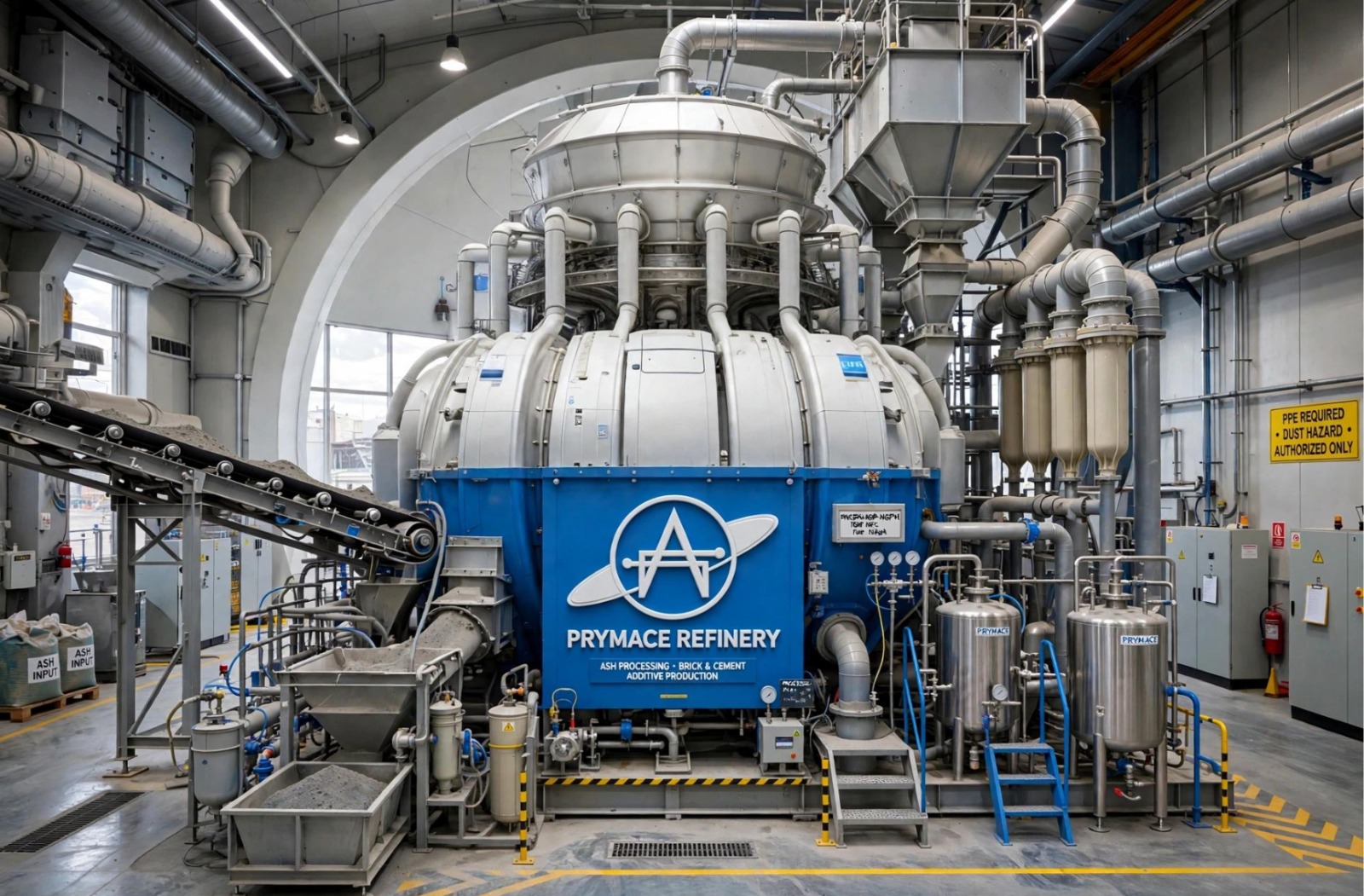
PrymACE Refinery — Where Residuals Become Materials
The PrymACE journey does not end when valuable materials are recovered at the Mine.
What remains may still contain usable material value.
At PrymACE Refinery, residual ash and other suitable material streams are characterized, stabilized, classified and further processed to develop materials for practical applications.
The Mine recovers. The Refinery transforms what remains.
PrymACE Refinery is therefore designed as the final material-development and product-generation stage of the five-Pool resource system.
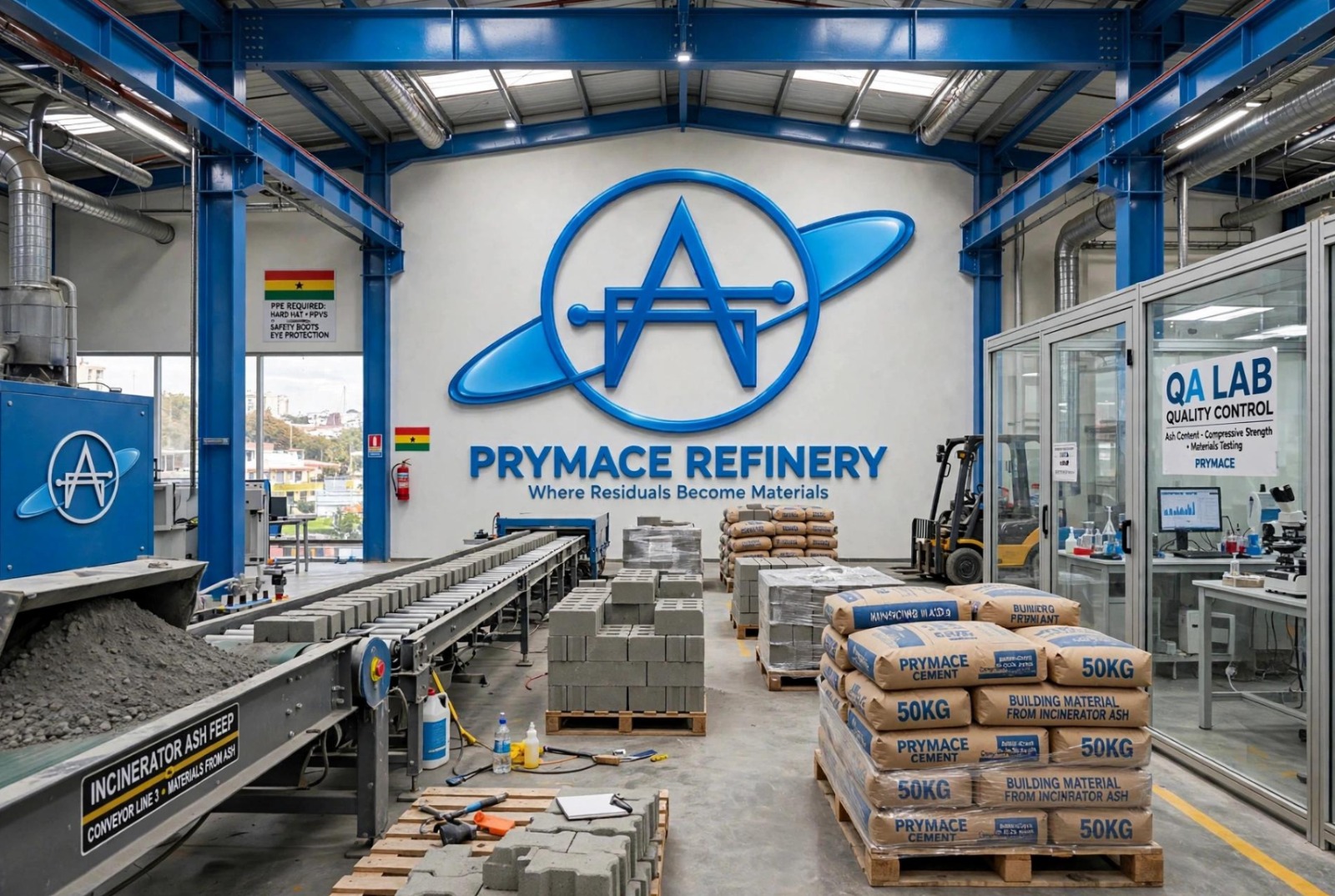
From Residuals to Materials
The Refinery process follows a controlled material-development pathway:
Residual does not automatically mean useless. The Refinery evaluates what remains and determines whether it can be technically transformed into a safe, useful and commercially viable material.
-
1
Residual Ash / Material — The Refinery Starts Where Primary Recovery Ends
PrymACE Mine performs primary recovery of valuable components from Ash Ore. Following this operation, a residual material stream remains. Depending on its composition and characteristics, this material may contain mineral fractions, inorganic compounds, silica- or alumina-bearing materials, calcium-containing fractions, other mineral constituents, processed aggregates, or other potentially useful material components. The Refinery receives suitable residual streams for further evaluation. The objective is to discover what further value remains.
-
2
Characterization — Understand the Material Before Reformulating It
Every residual stream must first be understood. The Refinery can establish a material profile through appropriate laboratory testing and analysis. Depending on the intended application, characterization may examine chemical composition, physical properties, particle-size distribution, moisture, density, leachability, contaminants, stability, mechanical properties and other application-specific parameters. This information determines whether the material is suitable for further treatment and what processing pathway may be appropriate. Characterization turns an unknown residual into a defined material.
-
3
Stabilization — Make the Material Suitable for Handling and Use
Some residual materials may require stabilization before further processing or application. Stabilization is designed to control undesirable physical or chemical characteristics and improve the material’s suitability for subsequent processing. Depending on the material, appropriate techniques may involve conditioning, blending, moisture control, chemical stabilization, solidification, or other validated treatment methods. The objective is to produce a stable and manageable material stream appropriate for the next processing stage. Safety and suitability come before commercialization.
-
4
Classification — Every Material Needs a Destination
After characterization and stabilization, materials are classified according to their properties and intended applications. The system can determine whether a material is suitable for pathways such as building materials, construction materials, agricultural materials, art & creative materials, manufacturing materials, or other applications. Classification prevents a one-size-fits-all approach. Different materials require different applications.
-
5
Processing — Convert Material Characteristics Into Material Performance
Classified materials undergo the processing required for their intended application. Potential operations may include grinding, milling, screening, blending, drying, particle-size adjustment, compounding, thermal treatment, chemical treatment, or other appropriate processes. The specific process depends on the material and the target product. The objective is to modify the material’s properties so that it can perform a defined function. Processing turns material potential into material performance.
-
6
Formulation — Engineer the Material
A residual material may not be suitable for direct application. The Refinery can therefore combine it with other compatible materials to develop a controlled formulation. A formulation may be engineered around requirements such as strength, durability, workability, density, particle structure, moisture resistance, chemical stability, thermal characteristics, or other application-specific requirements. This is where the Refinery moves beyond resources processing into materials engineering. The objective is not simply to reuse the residual — the objective is to engineer it into something useful.
-
7
Material Development — From Processed Resource to Engineered Material
The formulated material enters a development stage where its performance is evaluated against the requirements of its intended application. The development process can include prototype production, laboratory testing, performance evaluation, formulation adjustment, pilot production, quality verification and product specification. Only materials that meet the relevant technical and safety requirements should progress toward commercial application. The Refinery converts residual resource streams into engineered material solutions.
-
8
Finished Products — Materials Ready for Application
The final stage is the development of finished products or material inputs suitable for their validated applications.
Potential Product Families
Building
Building components, additives, aggregates and other appropriately engineered materials.
Construction
Construction materials, fillers, binders, paving-related materials and other suitable products.
Agriculture
Appropriately characterized and regulated soil or agricultural materials where technically and legally suitable.
Art
Creative materials, pigments, composites and other material applications where safety and performance requirements are satisfied.
Manufacturing
Material inputs, fillers, compounds and other industrial feedstocks.
Other Applications
New applications developed through research, testing and innovation.
The Refinery Is Not Simply a Storage Facility
It is a material-development system.
The final Pool of PrymACE is designed around a fundamentally different philosophy.
A conventional disposal chain ends with: resources → dump.
PrymACE seeks to continue the material journey: residual → characterize → stabilize → process → formulate → develop → product.
The Refinery therefore represents the point where the resource economy reconnects with the manufacturing and consumer economy.
The Material Development Loop
The Refinery can operate as an iterative development environment.
This creates opportunities for continuous materials innovation. A material that does not initially meet an application requirement can be reformulated, retested and redirected toward another application where its characteristics are more appropriate.